

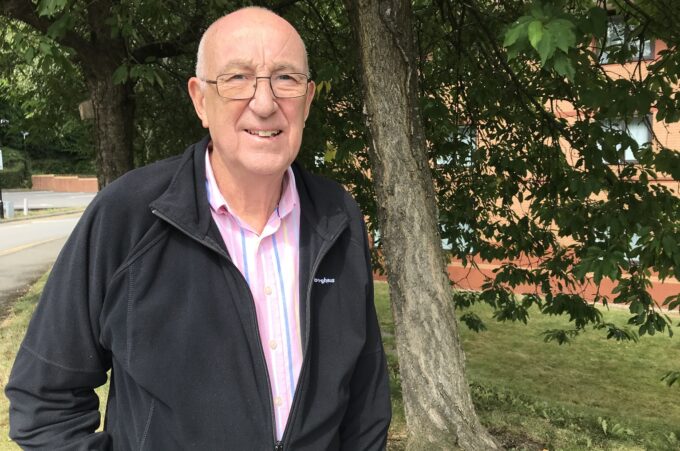
Retired lecturer Patrick Cullen has inclusion body myositis (IBM). This is his experience of taking part in research
I think I must be a medical trial junkie. I’ve taken part in two clinical trials, and I’ve already signed up for a third.
Is there a recognised medical condition for that? If not, I’d like to propose one: Guinea Pig Syndrome. The symptoms probably include an unreasonable optimism about hospital parking.
It all started back in 2003 when I was diagnosed with testicular cancer.
Following surgery, and after I’d been given the all-clear, my consultant asked whether I’d consider taking part in a trial evaluating a relatively new type of body scan called PET—positron emission tomography.
Back then PET scans were still fairly new. My consultant explained exactly what the trial involved, answered my questions, and made it perfectly clear that saying “no” was absolutely fine.
I remember thinking, “Well, somebody has to find out whether this works.” So I agreed.
Close monitoring
One of the unexpected benefits of taking part in research is that you suddenly become extremely well looked after.
You see more consultants. More specialist nurses. More researchers. You’re monitored far more closely than under routine care.
In my case, that extra attention paid off. The PET scan found a hotspot, possibly a tumour, in some lymph nodes in my abdomen.
Three months of chemotherapy later it had disappeared. I then had 10 years of follow-up.
Did that trial detect something that might otherwise have been missed? I’ll never know. I’d like to think it did. It certainly makes for a better story.
In the genes
Looking back, though, perhaps none of this should have come as a surprise. Maybe it really is in my genes.
My grandfather, Christopher Edward Cullen, was an Irishman with Type 1 diabetes. I have newspaper cuttings from the time showing that he, together with a young boy, was among the first people to receive insulin as part of the early insulin trials in London.
Imagine the courage that must have taken. At that time, 1920s, Type 1 diabetes was effectively a death sentence. Insulin wasn’t an established treatment—it was an experiment. Nobody knew whether it would work.
Sadly, the young boy who took part alongside my grandfather died. My grandfather survived.
Insulin gave him another 10 or so years of life. Those years gave him the opportunity to marry, raise a family and, eventually, have a grandson who seems genetically incapable of saying no whenever someone asks, “Would you like to join a clinical trial?”
Leap of faith
So perhaps Guinea Pig Syndrome is hereditary. Every treatment we now take for granted was once somebody else’s leap of faith.
Fast forward another 20 years and life threw me another curveball. I was diagnosed with inclusion body myositis, a muscle wasting condition.
Unlike cancer, there is no treatment. No cure. No approved drug.
When you hear those words, you become remarkably good at internet searches.
You type things like “IBM breakthrough”, “new IBM drug”, and “latest research”. After about twenty minutes you’re reading about miracle cures involving seaweed, turmeric and a dodgy therapist living in Nebraska.
Eventually common sense returns. Fortunately I was under the care of Dr Lilleker, who mentioned there might be a new drug trial starting in Manchester, testing a new drug to fight IBM.
An armful…
I happened to be in exactly the right place at exactly the right time and I qualified.
For the next two years I travelled to Salford Royal every eight weeks.
One unexpected luxury was that the trial arranged taxis. Now, if you’ve got a muscle-wasting condition, that isn’t just convenient. It’s wonderful. No motorway driving. No hunting for a parking space. No wondering whether you’d have enough energy left to get yourself home afterwards.
A typical trial visit lasted about five hours.
The glamorous world of medical research isn’t quite what people imagine. There’s no dramatic laboratory. Nobody rushes in shouting, “We’ve made a breakthrough!”
It’s mostly waiting. Forms. Blood tests. And more waiting. The day always began with the research nurse asking how the previous eight weeks had gone.
Any infections? Any new medication? Any falls? Any hospital visits?
Then came the blood tests. Nine or 10 tubes was fairly common. The record, I think, was 21. As Tony Hancock once said… “…that’s more than an armful.”
By the end I was beginning to wonder whether they were leaving enough behind to keep me upright.
Kindness matters
The research nurses, though, were absolutely wonderful. They remembered your name. They remembered conversations from two months earlier. They remembered your family. They remembered your holidays. They somehow managed to make spending five hours in hospital feel almost enjoyable.
That kindness matters more than you probably realise.
Eventually Dr Lilleker would arrive. We’d complete questionnaires—including the famous suicide questionnaire, which always seemed slightly surreal after we’d spent ten minutes cheerfully discussing holidays.
Then came muscle strength testing. Push. Pull. Lift. Resist. All things I used to think I was rather good at.
Eventually the pharmacy released the study medication…….. Or perhaps it didn’t.
Because, of course, nobody knew. The injection might have contained the new drug. It might have been placebo.
Trust the process
That’s one of the strange disciplines of taking part in a blinded clinical trial. You faithfully attend every appointment. You have every blood test. You organise your diary around the study. Yet you have absolutely no idea whether you’re receiving the treatment you’re hoping for. You simply trust the process.
People often ask why anyone would volunteer for something like that. Partly, of course, it’s hope. Every patient hopes. You’d be lying if you said otherwise.
But it’s something else as well. If nobody volunteers then nothing changes.
Every treatment we use today exists because someone, somewhere, agreed to become the guinea pig.
A few weeks ago we received the final trial results. Sadly, the drug showed no statistically significant improvement. The trial was stopped.
I was surprised by how disappointed I felt. For two years I’d quietly carried around a little bit of hope. Then, suddenly, it was gone.
It’s rather like grieving for a future that never actually existed. I think that’s something patients sometimes experience but don’t often talk about. Research involves emotions as well as science.
Trying again
But here’s the thing. I’d do it again tomorrow. In fact, I’m already trying. I’ve now signed up for an observational study looking at exercise and diet in IBM.
No injections this time – at least I hope not. No placebo. Just the exciting possibility that broccoli and quinoa might finally justify all these years of pretending to enjoy them.
And to any other patients who are ever asked to consider taking part in research, I’d simply say this.
Ask questions. Find out what’s involved. Speak to your family because it affects them too. Think about it carefully. Because even if you never personally benefit, you may help the person sitting in your chair five years from now.
My grandfather took a leap of faith with insulin. I took one with PET scanning and I’ve taken another with an IBM drug trial.
None of us knew where those journeys would lead but – that’s research.
IBM still doesn’t have a cure. Not yet. But it has dedicated researchers. Committed clinicians. Research nurses with endless patience. And patients who keep saying yes.
Progress rarely arrives in one spectacular breakthrough. It usually comes from thousands of ordinary people quietly giving a little of their time, a little of their trust—and occasionally rather a lot of their blood.
I may never personally benefit from the research I’ve taken part in but I genuinely hope somebody else will.
- Patrick blogs about his experience of IBM on Substack: https://substack.com/@ibmisapain