

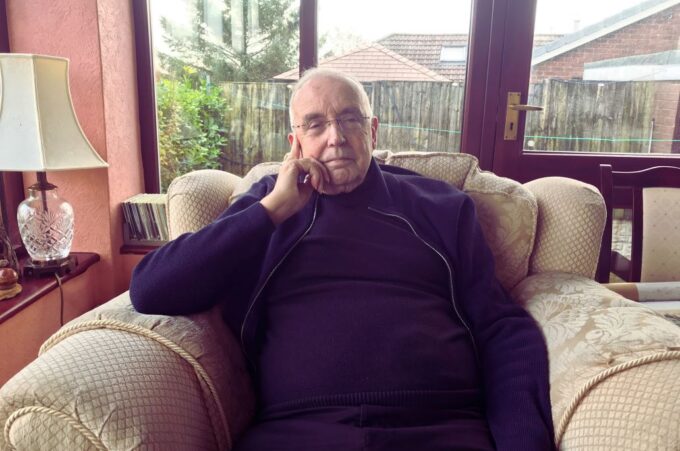
Talk to David Acton for just a short while and it’s easy to see why he leapt at the chance to take part in research.
An entrepreneur and businessman with a whole host of technical and marketing successes in the textile world behind him, he’s also devoted a great deal of time to initiating and supporting community projects through the Rotary movement.
Wanting to improve things is in his DNA so when he was asked to take part in a clinical study for Parkinson’s disease, David didn’t hesitate. “I’m a strong believer in helping where I can,” he said. “I knew that further down the line, this may prevent someone else going through what I did.”
David took part in the Cobalt study, a clinical trial funded by the National Institute for Health and Care Research to determine whether the prescription drug memantine, used together with standard cholinesterase inhibitors, may help to improve memory, awareness and the ability to perform daily tasks.
The invitation came at the right time for David, who’d been diagnosed with Parkinson’s disease dementia at Christmas 2021 after collapsing at home. Alongside other health conditions – including heart disease, prostate problems and a colostomy – the illness had left him at a very low ebb.
Incredible change
His wife Sheila explained: “He was losing the thread of conversations, couldn’t remember what day of the week it was or some people’s names, was struggling with food and had lost the ability to write and draw. He’s always been a sociable person but he changed completely. The voice was there but the man inside had gone.”
The couple, who live in Rochdale, knew there was a chance that David might receive a placebo rather than the treatment but felt it was a risk worth taking.
While the study is yet to report its findings, David and Sheila say the difference it has made to him has been dramatic. “The change is incredible,” said Sheila. “You wouldn’t believe how he has come back. When the research team from Fairfield General Hospital came for a home visit three months into the study, they were stunned to see David sitting at the table writing – just a few weeks earlier, he hadn’t even been able to draw a circle.”
His regained abilities and confidence have seen him pick up the threads of one of his passions, the ‘Home Farmer’ Rotary project. This builds on a previous multi-national programme, where he and colleagues supported people to grow vegetables in supermarket carrier bags.
He recently stood to give a presentation on the project which will encourage people throughout the UK to grow food for themselves, with benefits for mental and physical health as well as communities and the climate. He may not be doing the digging himself but he says his improved mental state has meant he’s ready to make his mark on the project – even at the age of 84.
“Thank God for the NHS, every turn we’ve made in it has been good,” he said.