

Advanced critical care practitioner Beth Howard is blazing a trail for nurse and allied health professional research in critical care.
She’s been appointed as a clinical research fellow in NCA’s Centre for Clinical and Care Research, in a six-month post that will see her supporting career development for fellow nurses, practitioners and AHPs through research.
Her appointment follows on from her first principal investigator role working on a large NIHR-funded national study alongside Sarah Howe, a respiratory and critical care physiotherapist.
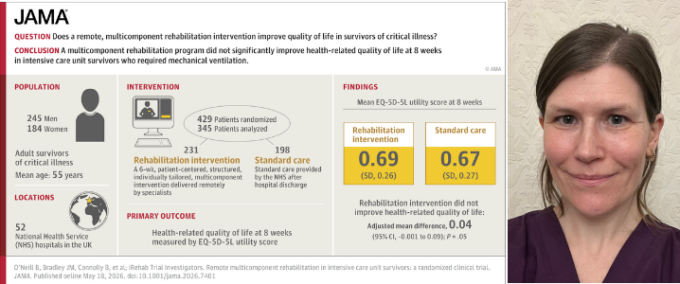
The iRehab study looked at whether a remote rehabilitation programme – including symptom management, targeted exercise, psychological and peer support – would improve outcomes in patients discharged from the intensive care unit (ICU) after being on a ventilator for at least two days.
Although it was their first direct involvement in delivering a national trial, both Beth and Sarah have considerable experience of developing a multi-disciplinary approach to supporting patients in their recovery after leaving the ICU.
Survivors of critical illness often experience ongoing physical deconditioning, respiratory and swallowing problems, reduced activities of daily living, cognitive and mental health impairments, fatigue, and impaired overall health-related quality of life.
Refining service
The study evaluated the effects of a six-week, remote, personalized rehabilitation programme compared with standard care on health-related outcomes at eight weeks among critically ill patients who required mechanical ventilation for 48 hours or longer and who were discharged to home. Nationally 429 patients took part in the study, which found that the programme didn’t improve health-related quality of life, although patients did have improved leg strength and exercise capacity, while reducing fatigue and anxiety.
Although the main results might have been disappointing, Beth says the team’s involvement in the study was helpful in taking a deep dive into the Follow up and Rehabilitation service for critical care patients and refining what is offered and how.
She said: “The post-discharge service has traditionally been nursing led so this was also an important milestone in incorporating the role of other AHP practitioners into this recovery pathway.
“During my CCR fellowship, I’ll be building on the enthusiasm there already is in the multidisciplinary team for research and embedding it in practice. It adds another aspect to your working life and to job satisfaction, knowing that you are contributing to improving the patient experience and recovery.”
Critical care consultant Professor Paul Dark was a co-investigator for the iRehab study, which was also supported by Dominic Kay from the acute research delivery team who screened over 1,000 patients over the course of the trial to establish their eligibility to take part.
The study has now been reported in the prestigious Journal of the American Medical Association: Remote multicomponent rehabilitation in intensive care unit survivors – a randomized clinical trial.